
In-State vs. Out-of-State College Admissions: UC, UT Austin, Michigan & Harvard
Nov 03, 2026
The Geography of College Admissions: Why Your Home State Can Change Your Odds at America's Top Universities
By Mrs. Gencheva | VoicED Academy | College Admissions Analysis, November 2026
Two students have nearly identical academic records. Both have earned outstanding grades, taken demanding coursework, shown intellectual curiosity, and built impressive extracurricular accomplishments.
One lives in California. The other lives in Texas.
Both apply to the University of Texas at Austin.
Despite their similar qualifications, they are not competing under the same admissions conditions. The Texas student may qualify for a state-mandated pathway to automatic university admission. The California student does not.
Now consider a Massachusetts student applying to Harvard University. Does that student gain a comparable advantage simply because Harvard is located in Cambridge?
No. And understanding why reveals one of the most consequential, and frequently misunderstood, distinctions in American college admissions.
At selective public universities, residency can fundamentally change the admissions process. At elite private universities, geographic considerations operate differently.
The distinction isn't simply about preferring local students. It involves state law, taxpayer investment, enrollment capacity, university finances, institutional priorities, and, in some cases, entirely different admissions pathways.
For families building college lists, misunderstanding these differences can lead to unrealistic expectations, poorly balanced applications, and missed opportunities.
1. Harvard Is Not the University of Michigan: Public Versus Private Admissions
Harvard, Stanford, MIT, Yale, and Princeton are private universities. Although they receive federal research funding and benefit from various public programs and tax advantages, they are not state universities charged with reserving undergraduate seats for residents of their home states.
A student living in Massachusetts does not receive a statutory Harvard admissions preference comparable to the preference a Michigan resident receives at the University of Michigan.
Similarly, living in California does not grant a student an automatic admissions advantage at Stanford.
This does not mean geography is irrelevant to private university admissions.
Highly selective private universities often consider geographic diversity when building an undergraduate class. A qualified applicant from an underrepresented region may contribute something different to the entering class than another applicant from a heavily represented metropolitan area.
But geographic diversity is not the same as an in-state admissions quota.
Harvard does not operate a public-university-style system that guarantees Massachusetts taxpayers a designated proportion of undergraduate seats.
The distinction matters because a public university's legal purpose differs fundamentally from that of a private university.
Public universities have an obligation to serve the state that established and supports them. Private universities pursue their own educational missions, subject to applicable law, without the same state-residency enrollment mandates.
2. The University of California: A System That Challenges the Conventional Wisdom
The University of California provides one of the most interesting examples of how residency affects admission.
California operates a public university system with nine undergraduate campuses, including UC Berkeley, UCLA, UC San Diego, UC Irvine, UC Davis, and UC Santa Barbara.
The state has made expanding access for California residents a major institutional priority.
In July 2026, UC announced it offered admission to a record 102,031 California first-year applicants for fall 2026, with a statewide resident admission rate of about 78%. About 85% of UC's enrolled undergraduates were California residents.
Source: UC Office of the President, July 29, 2026 admissions release.
FALL 2026 • UC SYSTEM
102,031
California first-year students offered admission
78%
California resident systemwide admission rate
UC Office of the President, preliminary fall 2026 admissions release.
However, one must distinguish between admission to at least one UC campus and admission to a particular campus.
A California student might be admitted to UC Riverside or UC Merced while being denied admission to UCLA or Berkeley. The systemwide acceptance rate does not describe that student's chances at each institution.
More surprisingly, California residency does not necessarily produce a higher published acceptance rate at every UC campus.
Fall 2025 UC admission rates by residency
The following figures are drawn from the California Legislative Analyst's Office, using its published fall 2025 resident and combined nonresident statistics. Nonresidents include domestic out-of-state and international applicants.
Source: California Legislative Analyst's Office, The 2026–27 Budget: Nonresident Tuition Rates at UC, Figure 6. Rates are rounded.
UC admissions: residency does not always mean higher acceptance
Fall 2025 freshman admit rates, percentages. Nonresidents include U.S. out-of-state and international applicants.
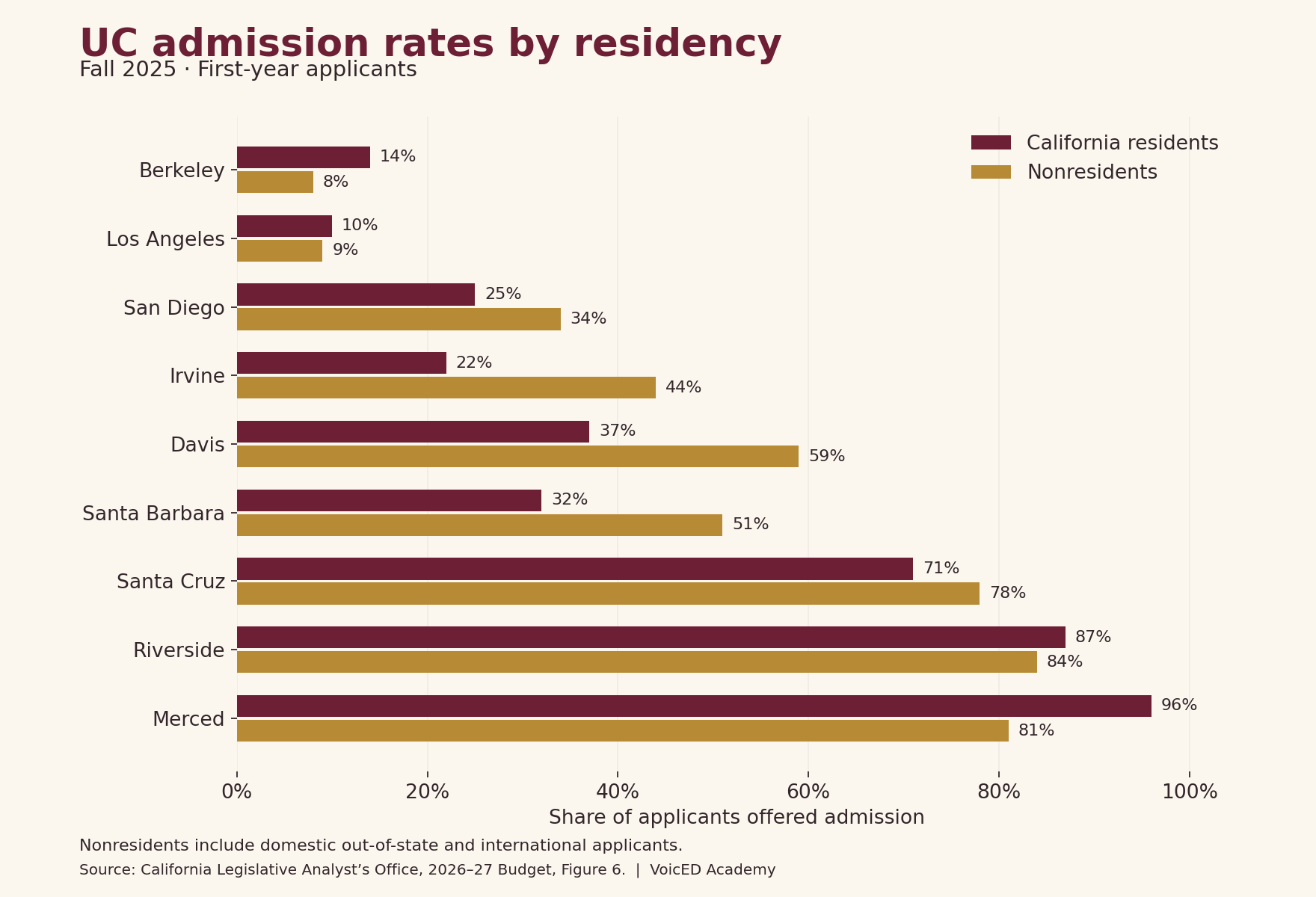
These numbers challenge the familiar assumption that California students always enjoy better statistical admission odds than applicants from other states.
At UC Davis, for example, the combined nonresident admission rate was approximately 59%, compared with 37% for California residents.
At UC Irvine, it was approximately 44% versus 22%.
Yet at Berkeley, the California resident admission rate was higher: approximately 14%, compared with 8% for nonresidents.
How can a state university prioritize its residents while admitting a higher percentage of nonresident applicants at certain campuses?
The answer lies partly in the difference between admission rates and enrollment composition.
A university can admit a relatively high proportion of nonresident applicants and still enroll a predominantly resident undergraduate population. Many nonresident students who receive offers ultimately choose another institution, often because of cost.
The UC legislative analysis demonstrates this distinction through yield rates. In fall 2025, UC Davis's resident yield rate was about 21%, compared with 7% for nonresidents. At UC Irvine, the respective figures were 26% and 9%.
In other words, nonresident applicants may receive admission offers at a higher rate but enroll at a substantially lower rate.
Another statistical complication: the applicant pools are not identical. Their academic preparation, financial circumstances, school choices, intended majors, and likelihood of enrollment may differ.
A higher nonresident acceptance rate does not prove that an equally qualified out-of-state applicant receives preferential treatment. It simply describes the proportion of applicants admitted from that particular pool.
Why Berkeley and UCLA are different
At the two most selective UC campuses, demand from qualified applicants substantially exceeds the number of available seats.
Berkeley and UCLA attract large numbers of applicants from California, other states, and internationally. Both also operate within a system facing political pressure to protect California access.
This makes the residency distinction especially consequential.
But even for California residents, neither university should be treated as a predictable admission.
A student with exceptional grades, advanced coursework, and strong activities can still be denied because the applicant pool contains far more qualified students than either campus can accommodate.
Residency affects the institutional framework within which an applicant is considered, but it does not guarantee admission.
The hidden UC factor: Major selection
Another important consideration is the student's intended field of study.
A California applicant interested in computer science, engineering, nursing, or another highly constrained program may face a very different competitive environment from a student applying to a less capacity-restricted field.
For example, a family looking only at UC San Diego's overall admission rate may conclude that admission is relatively attainable. But that number does not indicate the likelihood of admission to a selective major or guarantee later access.
Some UC campuses admit students to specific majors or colleges, while others have more flexible admission structures. Switching into an impacted program after enrollment may be restricted or highly competitive.
For families, this means one key strategy: evaluate the campus, residency category, and intended academic program—not just the university's headline acceptance rate.
3. University of Texas at Austin: When State Residency Creates an Entirely Different Admissions Pathway
The University of Texas at Austin is among the clearest examples of how state policy can fundamentally change the admissions landscape.
Texas doesn't just encourage its flagship university to enroll Texas students. It has established a statutory automatic-admission system that gives certain Texas high school graduates a pathway unavailable to out-of-state applicants.
Under UT Austin's policy, eligible Texas students who graduate in the top 5% of their high school class qualify for automatic university admission for the fall 2026, fall 2027, and fall 2028 entry cycles, subject to the applicable requirements.
The university's automatic-admission system is structured to fill 75% of the available spaces designated for Texas residents through this pathway.
Sources: UT Austin admission review; Texas Education Agency: 2028 automatic-admission policy.
This is not a minor admissions preference. It fundamentally changes how the institution allocates a substantial portion of its entering class.
Why the 75% figure matters
Suppose, purely for illustration, UT Austin designates 9,000 first-year places for Texas residents.
Under the statutory structure, approximately 6,750 of those resident places would be allocated through automatic admission, leaving approximately 2,250 for other Texas residents considered through holistic review.
This is a hypothetical illustration, not UT Austin's actual seat count.
An out-of-state applicant cannot access the Texas automatic-admission pathway. Instead, that student competes through the nonresident admissions process, subject to institutional enrollment priorities and available capacity.
UT Austin has historically reserved roughly 90% of its freshman places for Texas residents, although the precise application of residency and enrollment policies should be checked for each entering class.
Automatic admission does not guarantee your major
This is where many families make a consequential mistake.
Automatic admission to UT Austin does not necessarily mean automatic admission to the student's preferred academic program.
A Texas student who qualifies through the top-5% pathway may receive university admission but still face competitive review for a major such as computer science, business, engineering, or another capacity-constrained program.
UT Austin explicitly identifies the competitiveness of the selected major as a factor in its holistic review.
Source: UT Austin: Review & Decision Process.
Consider two applicants:
Student A: Texas resident
A student graduates in the top 5% of an eligible Texas high school class and applies to computer science. The student may qualify for automatic admission to the university, but admission to the computer science major remains a separate question.
Student B: California resident
A student has equally strong academic credentials, extensive programming experience, and meaningful research accomplishments. The student does not qualify for the Texas automatic-admission pathway and must compete for admission as a nonresident.
Even if both students have identical SAT scores and similar academic achievements, their institutional pathways are different.
Neither should assume that admission to UT Austin automatically guarantees a place in the desired major.
Why UT Austin is particularly challenging for out-of-state applicants
UT Austin combines several forces that make nonresident admission especially competitive.
First, the university has a statutory obligation to provide substantial access to Texas residents.
Second, the automatic-admission system allocates much of the resident capacity before the remaining holistic decisions are made.
Third, highly sought-after programs such as computer science, engineering, and business face intense demand.
Finally, Austin's growth as a technology and business center has made the university nationally attractive to applicants.
A California student who views UT Austin as a comfortable alternative to Berkeley, UCLA, or Georgia Tech may therefore be misjudging its selectivity.
UT Austin should not be classified as a safety school for an academically outstanding out-of-state applicant.
This is especially important for students pursuing competitive majors. A strong academic record establishes eligibility to compete; it does not overcome structural capacity limits.
Financial implications
The Texas advantage also extends beyond admission.
For Texas residents, UT Austin currently publishes estimated annual undergraduate tuition of approximately $10,858–$13,576, depending on the program. Its Texas Advance Commitment provides tuition support for eligible resident families based on household income.
Source: UT Austin: Cost of Attendance.
Out-of-state families face a different tuition structure and should not assume the same state-funded affordability programs apply.
This creates a double advantage for many Texas families: a favorable admissions pathway and lower attendance costs.
4. University of Michigan: A Threefold Difference in Admission Rates
The University of Michigan at Ann Arbor provides one of the most striking contemporary examples of residency-based admission disparities.
Unlike UT Austin, Michigan does not use an equivalent statewide top-5% automatic-admission guarantee for its flagship undergraduate admissions.
Nevertheless, its resident and nonresident admission rates differ dramatically.
Michigan's fall 2025 admissions data
MICHIGAN RESIDENTS
42%
Admit rate
OUT-OF-STATE
13%
Admit rate
Source: Michigan Almanac: Undergraduate Admissions & Enrollment, Figures 2.1 and 2.2.1.
The overall first-year admission rate was approximately 16%.
Michigan received 109,112 first-year applications for fall 2025, admitted 17,915 students, and enrolled 8,178.
These numbers demonstrate why an overall admission rate can conceal an important distinction.
An in-state applicant was admitted at more than three times the rate of an out-of-state applicant.
That does not mean an individual Michigan resident with a particular GPA has precisely three times the probability of admission. It means the two applicant pools had dramatically different aggregate outcomes.
Michigan's selectivity has changed significantly
The university's own historical data show how competition has intensified.
The out-of-state admission rate fell from 25% in fall 2016 to 13% in fall 2025. The trend was not a continuous annual decline; it rose to 22% in 2020 and from 12% to 13% in 2025. Michigan resident rates were 44% in 2016 and 47% in 2020.
A widening challenge for nonresident applicants
University of Michigan first-year admission rates, fall 2016–2025.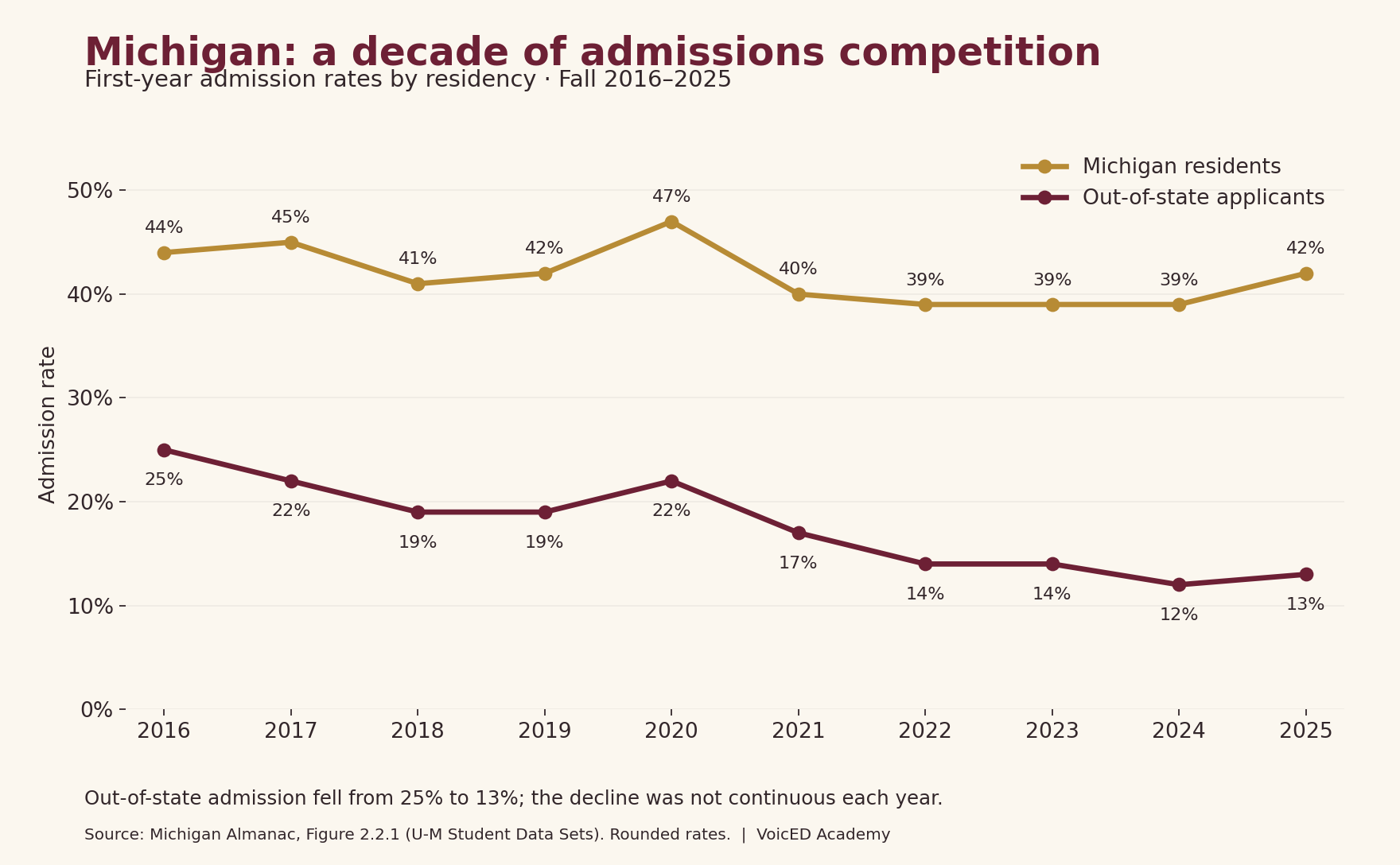
For out-of-state families, the implication is significant.
A university that may have seemed relatively attainable a decade ago has become substantially more competitive, particularly for students without Michigan residency.
The enrollment yield explanation
Michigan's data also illustrate why admissions offices care about whether an admitted student will actually enroll.
In fall 2025:
-
Approximately 78% of admitted Michigan residents enrolled.
-
Approximately 31% of admitted out-of-state students enrolled.
These are the university's published yield rates.
Imagine Michigan admits 100 qualified in-state students. Based on that historical yield, approximately 78 might enroll.
If Michigan admits 100 out-of-state students, approximately 31 might enroll.
This is an enormous difference for an institution attempting to predict class size, housing demand, course capacity, and revenue.
However, yield should not be confused with proof that Michigan rejects individual out-of-state applicants because it assumes they will attend another university.
Michigan's published statistics establish the yield difference. They do not, by themselves, show how much predicted enrollment influences individual admissions decisions.
The more defensible conclusion is that residency, institutional enrollment priorities, applicant composition, and yield collectively shape the admissions landscape.
For an out-of-state applicant interested in Michigan's Ross School of Business, College of Engineering, or another selective program, program-specific admission policies create an additional layer of competition.
A family should therefore examine both residency and school or college selection before treating Michigan as a realistic target.
5. University of Virginia: The Two-Thirds Resident Commitment
The University of Virginia offers a particularly transparent explanation of the residency divide.
UVA has committed to keeping about two-thirds of its student body as Virginia residents.
Yet approximately two-thirds of its applicants come from outside Virginia.
This creates a striking imbalance between applicant demand and the institution's enrollment priorities.
UVA's published fall 2025 class profile reports the following overall admission rates:
24%
Virginia residents
13% Out-of-state applicants
The university reported that about 67% of its entering class were Virginia residents.
University of Virginia Admission
This is a meaningful admissions advantage, but it is important to describe the policy correctly. UVA's two-thirds resident commitment is an institutional enrollment target, not a rule that exactly two-thirds of admission offers must go to Virginia applicants.
Early Decision and Early Action do not erase residency differences
UVA's fall 2025 data also allow comparisons by application round.
| Application round | In-state offer rate | Out-of-state offer rate |
|---|---|---|
| Early Decision | 30% | 21% |
| Early Action | 26% | 14% |
| Regular Decision | 12% | 9% |
| Overall | 24% | 13% |
Source: UVA Class of 2029 profile, offer and yield rates. Rates are descriptive, not controlled comparisons of equally qualified applicants.
University of Virginia Admission
Notice that out-of-state applicants faced lower admission rates across these application rounds.
Also notice that Early Decision had higher reported offer rates than Regular Decision for both groups.
This does not prove that applying Early Decision independently increases a particular student's probability of admission. The applicant pools differ, and Early Decision may include recruited athletes and other applicants with distinct institutional considerations.
Families should consider Early Decision only when the university is a genuine first choice and the binding financial commitment is appropriate.
6. UNC–Chapel Hill: When a Nonresident Enrollment Cap Is Explicit
The University of North Carolina at Chapel Hill is another prominent example of state-directed admissions policy.
UNC–Chapel Hill is subject to the Board of Governors’ nonresident enrollment policy. Effective fall 2025, its cap is 18% of the prior fall’s total first-time undergraduate enrollment. This is an enrollment limit, not an admission-offer rate.
This caps enrollment; it is not simply a statement that out-of-state students are less desirable.
The distinction is important.
A university with an 18% nonresident enrollment limit can admit more than 18% of its total offers to nonresidents because some of those admitted students will decline.
But it must manage the number who actually enroll to remain within its applicable policy.
Source: UNC Policy Manual: Nonresident Undergraduate Enrollment.
Consequently, a highly qualified applicant from New York, California, or New Jersey may face much more difficult admission conditions than a similarly prepared North Carolina resident.
UNC illustrates why public university admissions cannot always be understood through a purely national merit-ranking model.
The university is not simply selecting the strongest applicants from across the country without regard to residence. It is fulfilling a public mission within a state-governed enrollment framework.
7. Why Out-of-State Tuition Can Be Higher Even When Admission Is Harder
One apparent contradiction of public higher education is that out-of-state students often pay substantially more while competing for fewer seats.
Why would a university charge more to the very students it admits at lower rates?
The answer is that admission policy and tuition policy serve related but different purposes.
Taxpayer investment
State residents support public higher education through state taxes and other public revenue. In-state tuition generally reflects a public subsidy intended to make higher education more accessible to the state's residents.
Nonresidents have not ordinarily contributed to that state's tax base in the same way, so they are charged higher tuition.
This is the public-policy rationale, although individual families' tax histories can be more complicated.
Revenue diversification
Nonresident tuition can provide substantial revenue to a public university.
This revenue may support academic programs, faculty, research infrastructure, financial aid, and institutional operations.
However, it's inaccurate to assume every dollar of nonresident tuition directly subsidizes an in-state student's tuition or that universities always maximize nonresident enrollment.
State appropriations, enrollment restrictions, institutional financial aid, and university budgets complicate the financial relationship.
The financial tension
A public university may be incentivized to enroll tuition-paying nonresidents while also facing a legal or political obligation to maintain a predominantly resident student body.
That tension helps explain why public university enrollment policies can become politically contentious.
For families, the practical issue is equally important: a nonresident offer of admission may come with a substantially higher four-year cost.
A university can be academically attractive and still be a poor financial choice if the family must assume excessive debt or sacrifice financial stability to attend.
8. The Statistical Trap: Acceptance Rate Is Not the Same as an Individual Student's Chance
Consider two universities.
University A admits 40% of resident applicants and 15% of nonresident applicants.
University B admits 20% of both groups.
A family might assume that University A is automatically easier for every resident and harder for every nonresident.
But aggregate admission rates cannot answer that question on their own.
The calculation is straightforward: Admission rate = (Number admitted ÷ Number who applied) × 100
The formula does not capture the composition of the applicant pool.
Suppose 10,000 nonresident students apply to a university, and a disproportionate number have near-perfect grades, advanced coursework, strong test scores, and exceptional accomplishments.
Now suppose the resident pool includes a broader range of academic profiles because local students are more likely to apply to their flagship university.
The resulting admission rates reflect both university selection practices and differences in who applies.
This is why comparing two admission percentages is not the same as comparing the outcomes of two equally qualified students.
A sound admissions assessment should account for academic preparation, high school context, residency, intended major, application round, institutional priorities, and any published program-level restrictions.
It should also distinguish admission offers from actual enrollment.
Acceptance rates describe what happened to an applicant pool. They do not calculate a particular student's probability of admission.
9. What About Harvard, Stanford, MIT, and the Ivy League?
Private universities operate under different institutional obligations.
Harvard does not have to reserve a fixed proportion of seats for Massachusetts residents. Stanford is not required to prioritize California residents the way UC Berkeley must within California's public university framework.
MIT does not guarantee Massachusetts applicants an admissions pathway based on high school class rank.
But that does not mean MIT evaluates all applicants in a geographic vacuum.
Highly selective private universities may consider geographic representation, educational opportunity, school context, and the experiences students would bring to campus.
For example, an applicant from a rural school with limited advanced coursework may be evaluated in light of the educational opportunities available there.
A student attending a highly competitive high school in Silicon Valley may face a different school context and applicant environment.
Neither circumstance establishes a guaranteed preference or penalty.
The key distinction is between considering geography as context and a legally mandated resident enrollment allocation.
Harvard's location does not make Massachusetts residency an automatic advantage. Nor should families assume that an applicant from Wyoming receives a quantifiable admissions bonus simply because fewer students from that state apply.
Admissions are individualized, and institutions do not publish enough data to assign reliable, state-specific admission probabilities to otherwise identical applicants.
10. Five Admissions Scenarios Families Should Understand
Scenario 1: A California student applying to Michigan
The student has a 4.0 unweighted GPA, a rigorous AP curriculum, a 1530 SAT score, and strong extracurricular accomplishments.
The family sees Michigan's overall acceptance rate of approximately 16% and believes the student is a competitive applicant.
However, the fall 2025 nonresident admission rate was approximately 13%.
Michigan may still be an excellent application choice, but the student should not classify it as a safety school.
Scenario 2: A Texas student applying to UT Austin engineering
The student graduates in the top 5% of an eligible Texas high school class.
The student qualifies for the automatic university admission pathway but wants to study mechanical engineering.
The family must understand that admission to UT Austin and admission to the desired engineering major are not necessarily the same decision.
A student should never assume an alternative major guarantees a route into a competitive program later.
Scenario 3: A New Jersey student applying to UNC–Chapel Hill
The student has outstanding grades, leadership experience, and strong recommendations.
The family assumes UNC is less selective than an Ivy League university because its overall acceptance rate is higher.
But the relevant comparison is the nonresident applicant pool and the university's limited nonresident enrollment capacity.
UNC may be a reach even for an academically exceptional student.
Scenario 4: A California student choosing between UC Davis and UCLA
The student wants to study biological sciences.
The family observes that UC Davis has a substantially higher overall acceptance rate than UCLA.
That distinction matters, but the family must still consider academic preparation, the specific major, and the student's UC-calculated GPA.
The student should not interpret the systemwide UC resident acceptance rate of approximately 78% as a prediction of admission to UCLA.
Scenario 5: A Massachusetts student applying to Harvard
The student attends an academically rigorous Massachusetts high school, has exceptional academic credentials, and participates in significant extracurricular activities.
Living close to Harvard does not provide a statutory admission advantage.
Harvard will consider the application through its private-university admissions process, which evaluates academic preparation, accomplishments, personal qualities, context, and institutional considerations.
The family should not treat Harvard as more attainable merely because the student lives in Massachusetts.
What Does Your Student Need in a College?
Admission statistics tell only part of the story. A thoughtful college list also begins with how your student learns, what they value, and the environment in which they feel at home.
Explore the college-fit assessment offered by VoicED Academy: What Am I Looking for in a College? Use the self-survey and companion worksheet to clarify preferences and begin a more focused college-planning conversation. This reflection exercise does not predict admission or rank colleges.
11. What Families Should Do Differently When Building a College List
The implications extend far beyond one university.
A student can have an outstanding academic profile and still build an unbalanced college list by relying on overall acceptance rates.
A more responsible approach begins with five questions.
First, is the institution public or private? If it is public, investigate its obligation to serve state residents and whether that obligation is expressed through law, governing-board policy, or enrollment targets.
Second, what is the admission rate for the student's residency category? A 30% overall acceptance rate can conceal a much lower nonresident rate.
Third, does the university admit by major, college, or school? Admission to a university is not necessarily admission to computer science, engineering, business, or nursing.
Fourth, what is the realistic four-year cost? Out-of-state tuition and limited institutional aid can make a seemingly attractive offer financially difficult.
Fifth, what does the student actually want from the institution? Reputation alone is not a sufficient reason to apply. Students should also consider academic fit, access to programs, undergraduate opportunities, career outcomes, and financial feasibility.
These questions can produce a very different college list from one based on national rankings.
A student applying to UC Berkeley, UCLA, UT Austin, Michigan, UVA, and UNC may think the list mixes highly selective and moderately selective institutions.
For a California applicant, particularly one pursuing computer science or engineering, the list may instead contain six highly competitive choices.
Adding more prestigious public universities does not necessarily diversify admission risk.
12. The Larger Question: Who Are Public Universities Supposed to Serve?
The debate over resident and nonresident admissions ultimately concerns the purpose of public higher education.
One perspective emphasizes taxpayer responsibility.
State universities were established and supported to educate residents, strengthen the state's workforce, expand economic opportunity, and serve the public interest. From this perspective, giving residents priority is not an unfair exception to merit-based admissions; it is part of the institution's founding mission.
Another perspective emphasizes national academic opportunity.
Highly accomplished students may argue that they should be able to compete for admission to leading public universities regardless of where their families live. From this perspective, strict residency limitations can exclude exceptionally qualified applicants simply because they live across a state border.
Both arguments raise legitimate policy questions.
But families applying to college must distinguish between debating whether a system is fair and understanding how that system actually operates.
An admissions strategy cannot be built around how a family believes universities should select students. It must be built around the policies, priorities, and selection processes that exist.
Conclusion: Geography Is Not Destiny, but It Is Part of the Admissions Equation
The difference between resident and nonresident admission rates at selective public universities is not an accident.
It reflects decades of state investment, legislation, public policy, institutional enrollment planning, and competition for limited academic capacity.
At UT Austin, eligible Texas students can benefit from a statutory automatic-admission pathway.
At Michigan, the fall 2025 resident admission rate was approximately 42%, compared with 13% for out-of-state applicants.
At UVA, the university's commitment to maintaining a two-thirds Virginia student population creates a significant difference between resident and nonresident admission outcomes.
At the University of California, the picture is more complicated: California residents benefit from a system committed to expanding access, yet some campuses report higher nonresident admission rates because admission and enrollment are not the same.
Harvard, Stanford, and MIT have no equivalent state-residency admission entitlement.
The lesson is not that students should avoid applying outside their home states. Many public universities provide extraordinary educational opportunities to nonresident students.
The lesson is that families must understand the competition their student will actually face.
A university's overall acceptance rate is a statistic. A student's admissions strategy requires context.
The right question is not simply, “What percentage of students does this university admit?”
It is: “How does this university evaluate students like mine, applying from our state, to this particular academic program, and does the opportunity justify the cost?”
That is where thoughtful college planning begins.
Start with VoicED’s college-fit self-survey and worksheet.
About the author: Mrs. Gencheva founded VoicED Academy, an educational consulting practice that provides individualized academic and college admissions guidance. VoicED Academy helps students and families approach university selection with academic purpose, informed research, and realistic expectations.
Data note: Campus comparisons primarily use fall 2025 cohorts; the UC systemwide update is for fall 2026. Admission rates measure offers divided by applications. Yield measures enrollment divided by offers. Residency definitions and reporting methods differ by institution. These aggregate statistics do not predict an individual student’s admission outcome.
Is Your College List Strategically Balanced?
A strong academic record doesn't guarantee admission to a selective university, especially when residency policies, major restrictions, and institutional priorities shape the competition.
At VoicED Academy, we help students and families evaluate universities beyond rankings and overall acceptance rates. Our approach considers academic preparation, intended majors, residency, institutional fit, and financial considerations.
Ask about an individualized college admissions strategy consultation with Mrs. Gencheva.
Stay connected with news and updates!
Join our mailing list to receive the latest news and updates from our team.
Don't worry, your information will not be shared.
We hate SPAM. We will never sell your information, for any reason.
